Colin Chapman built his first car, based on an Austin 7, in a lock-up garage in Hornsey, North London in 1948, when he was only nineteen, with help from two friends. It and the car that followed were built for trials, a popular sport at the time that involved charging up steep, muddy tracks, but by 1951 Chapman had turned his attention to circuit racing. He formally founded the Lotus Engineering Company in Hornsey in January 1952. Early cars were sold in component form to private racers, partly to sidestep UK purchase tax on complete vehicles.
Chapman established his reputation as a brilliant designer with the space-framed Lotus Mk VI of 1952, which sold more than 100 examples. The race cars went from strength to strength through a string of model numbers that included the streamlined Lotus Eleven, a class winner at Le Mans in 1957.
The first road cars
1957 also saw the launch of Lotus’s first true road cars, the Seven and the Elite. The Seven was a minimalist concept: great fun, easy to build and easy to modify. Its basic design has been copied by countless other companies, often as a kit car, although for many enthusiasts only the Caterham Seven is a true evolution of the Lotus original. The Elite, with its monocoque glass-fibre body, was far more of a road-going sports car than any earlier Lotus.
Demand for the Seven and Elite soon outgrew Hornsey, and in 1959 the company moved to a purpose-built factory on Delamare Road in Cheshunt, Hertfordshire. Chapman insisted on a small gatehouse, modelled on the one at Vauxhall’s Luton factory, to complete the image. It was at Cheshunt that Team Lotus, the company’s motorsport division, won its first Formula One World Championship in 1963 with the revolutionary monocoque Type 25 and driver Jim Clark.
Elan, Europa and the move to Hethel
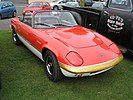
The Elite was handsome but complex to build, so almost as soon as it entered production Ron Hickman and other senior staff began work on a replacement. The result used a simpler glass-fibre body on a central backbone chassis. On paper that was a step back from the monocoque Elite, but time has shown it to be a sensible one: the new car, the Elan, became one of the most influential sports cars of all time. (Hickman later found fame as the inventor of the Black & Decker Workmate.)
Money was never far from being a problem, and to attract wealthier buyers the Elan was steadily moved upmarket through the 1960s, gaining electric windows, a wooden dashboard and full carpeting, as well as a longer fixed-head version, the Elan Plus 2. By the time the Plus 2 was ready, Lotus had outgrown Cheshunt too, and in 1966 it moved to a converted Second World War airfield, RAF Hethel, near Wymondham in Norfolk, where the company is still based. The 40-acre site, with its old runways, was ideal for performance testing.
Lotus saw out the Sixties with the Europa, a mid-engined sports coupé originally intended for mainland Europe only, hence the name. Based on a 1963 sketch by Ron Hickman, it marked the move from the Elan’s traditional sports car shape to the dramatic wedges of the 1970s Elite, Eclat and Esprit. Early Europas used Renault engines; the best-remembered version is the John Player Special Twin Cam, a spin-off from Chapman’s then-revolutionary idea of painting Formula One cars in a sponsor’s colours.
After Chapman
Team Lotus went on to win seven Formula One Constructors’ Championships and six Drivers’ Championships before withdrawing from the sport in 1994, twelve years after Chapman died of a heart attack in 1982, at a time when the company was going through one of its regular periods of turmoil. The road car business passed through several owners, including General Motors and Romano Artioli, before Malaysian firm Proton took control in the 1990s. Lotus kept making headlines with designs such as the Elise and the carbon-fibre Lotus bike ridden to Olympic gold, and it is now owned by the Chinese manufacturer Geely.