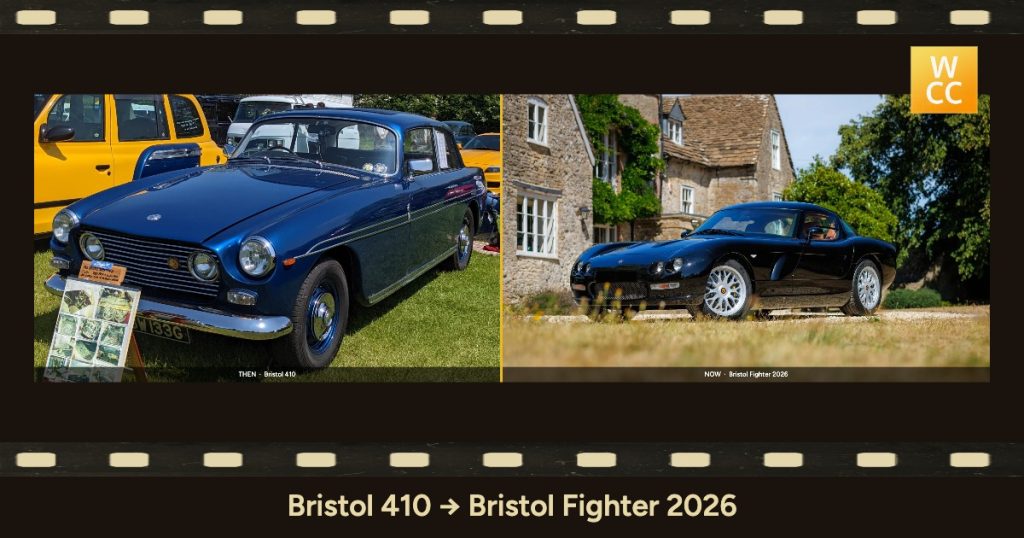
In some episodes of the BBC’s Inspector Lynley Mysteries, the aristocratic detective arrives at the scene in a Bristol 410: tall, dignified, quietly expensive, and one of only around 80 ever built. It was the perfect car for a man who never needed to announce his class.
Two decades later, Lynley has been rebooted, Bergerac has been rebooted, and Dalziel and Pascoe are being reimagined. British television has fallen in love with the second series. And so, it turns out, has Bristol Cars itself.
The company that built Lynley’s 410 closed its Filton factory in 2011, went into liquidation in 2020, and was written off by most of the motoring world. Then, in September 2026, a brand-new Bristol Fighter rolled onto the lawns at Blenheim Palace.
So this is a then-and-now story, but it’s also a detective story. A respected British marque vanishes. The trail goes cold. Rival claimants appear. And just when the case looks closed, the subject walks back into the room.
Let’s open the file.
On This Page
The Case File
Subject: Bristol Cars
Born: 1945–46, as an offshoot of the Bristol Aeroplane Company
Home: Filton, Bristol, later Patchway
Known address: A single showroom on Kensington High Street, London
Distinguishing features: Hand-built, aircraft-grade construction; understated styling; tiny production numbers
Last seen: Administration in March 2011; liquidation in March 2020
Sighted again: Salon Privé, Blenheim Palace, 2 September 2026
Part One: Then
Born From Aeroplanes (1945–1961)
Bristol Cars was a product of the end of the Second World War. The Bristol Aeroplane Company, which had built the Blenheim bomber and the Beaufighter, needed peacetime work for its people and its factory at Filton. It acquired an interest in Frazer Nash and set up a car division, drawing on BMW designs obtained after the war.
The result was the Bristol 400, launched in 1947. Its chassis was based on the pre-war BMW 326 and its engine derived from the BMW 328’s two-litre six. Around 700 were built, 17 of them with drophead bodies by Pininfarina.
What followed was a run of cars that are still admired for their engineering:
- Bristol 401 (1949): a slippery, wind-tunnel-shaped saloon that showed the aircraft influence
- Bristol 403 (1953): a refined, more powerful development
- Bristol 405 (1955–1958): Bristol’s only four-door saloon, with a hand-built aluminium body and that BMW-derived six. Only around 300 saloons were made.
The 405 has its own screen career. In Paul Thomas Anderson’s film Phantom Thread, Daniel Day-Lewis’s fastidious couturier Reynolds Woodcock drives one, a deliberate choice of a car that is expensive without being showy. That’s Bristol in a sentence.
The Chrysler Years (1961–1976)
By the early 1960s the Bristol six was ageing and expensive to build. Starting with the 407 in 1961, Bristol switched to Chrysler V8 engines from Canada. It was a pragmatic decision: more power, less cost, and an automatic gearbox that suited the cars’ long-distance, effortless character.
This period produced Lynley’s car:
The Bristol 410 (1968–1969)
- Around 80 built (sources give 79 or 82)
- 5.2-litre Chrysler V8, the last Bristol with that engine
- Smoother, more rounded styling than the 409, with the headlamps fully integrated into the wings
- Wheels reduced from 16 to 15 inches
- Revised braking system and a conventional lever automatic in place of push buttons
- A hidden compartment between the front wheel and the driver’s door that housed the battery, fuses, wiper motor and brake servos, a classic piece of Bristol thinking
Then came the Bristol 411 (1969–1976), with a larger Chrysler V8 and self-levelling suspension, developed through five series. Fewer than 300 were made, and it is the car the revived company named as its inspiration in 2024.
The Crook Years (1960–2001)
In 1960, after the aeroplane company was absorbed into the British Aircraft Corporation, the car business was bought out by George White. Racing driver and dealer Tony Crook took a 40% stake and became sole distributor, then bought White’s majority in 1973. Production moved to Patchway.
Under Crook, Bristol became famously idiosyncratic. It had one showroom, in Kensington, and built very small numbers. In 1982, the last year it published figures, it made just 104 cars. Models included the 412 and Beaufighter(1975–1993), the 603, Britannia and Brigand (1976–1993), and the Blenheim (from 1993).
The Last Hurrah: The Fighter (2004–2011)
After Crook sold to Toby Silverton and the Tavistock Group (completed in 2002), Bristol produced its most extraordinary car: the Fighter. It was a gullwing two-seater with an 8.0-litre V10 from the Dodge Viper and a claimed top speed of more than 200 mph. Bristol says just 15 were built between 2004 and 2011.
Hold on to that detail. Those leftover chassis are where this story turns.
Part Two: The Trail Goes Cold
3 March 2011: Bristol Cars went into administration. The Filton factory closed and 22 jobs were lost.
April 2011: The Kamkorp group bought the assets. In 2016 it showed a single prototype roadster, the Bullet. No production followed.
March 2020: The company entered court-ordered liquidation. Goodwood’s headline at the time declared Bristol officially dead after 75 years.
2021: Property developer Jason Wharton announced a revival. His plan included a Filton “atelier”, a reopened Kensington showroom, remastered 411, Fighter and Speedster models at around £495,000 plus VAT, and an electric Buccaneer for 2025. Deliveries were promised for 2022 and 2023. They didn’t happen, and the liquidators disputed his claims to the brand’s intellectual property.
November 2024: The Wharton camp tried again with “Vision 8.0”, pitching Bristol as a modern coachbuilder that would rebody other makers’ cars, starting with a modernised 411, in time for the brand’s 80th anniversary in 2026.
By this point many enthusiasts were treating Bristol revival announcements the way detectives treat anonymous tip-offs: interesting, but unproven.
Part Three: Now
The Body Walks Back In
On 2 September 2026, at Salon Privé at Blenheim Palace, a new Bristol Fighter was unveiled. It was finished, it was real, and it was built.
According to the company, Bristol Cars Group Ltd, and reports of the launch:
- It’s a continuation car, built on original, unused Fighter chassis left over from the 2000s. The original Fighter ran from 2004 to 2011, with just 15 built.
- This is billed as the final series: five chassis in total. One black car is complete and available to buy; four more will be built to order, in right- or left-hand drive, and one of those is already sold. Bristol says no further Fighters will be built after these.
- Power comes from the 8.0-litre Viper V10, with 525 or 600 bhp. There’s also a twin-turbocharged Fighter Toption claiming 1,012 bhp.
- The company is led by Paul King as director, with Richard Hackett as chairman. Hackett previously worked alongside the late Tony Crook.
- Prices are on application.
The relaunched company has its own website, bristol-cars.co.uk, with an enquiry form for the remaining Fighters.
One loose end remains. The September 2026 announcement names different people from the Wharton-era plans of 2021 and 2024, and nothing published so far explains how the two relate. A good detective notes the inconsistency and waits for more evidence.
Continuation, Not Reinvention
The approach is the clever part. Rather than trying to engineer a new car from scratch, which is what sank the earlier revival plans, Bristol has started by finishing what it left unfinished. Unused chassis, a proven engine, a known design.
It’s the same model that Jaguar, Aston Martin and others have used with their continuation series, and it suits a tiny company. It generates revenue and credibility before any bigger promises are made.
Whether the coachbuilt 411-inspired car, the Speedster, or the long-promised Buccaneer follow is the next chapter. On past form, it would be wise to wait for the cars rather than the press releases.
The Twist: Bristol and the Age of the Reboot
Here’s the thing that ties Bristol’s story to the detective shows it once starred in. Both are running on the same script.
Television has discovered that audiences love a familiar name done again:
- Lynley returned in 2025 on BritBox, and on BBC One in January 2026, with Leo Suter in the title role. A second series was announced in March 2026 and is filming in Dublin. The production chose a 1970 Jensen Interceptor Mk II for him, the same model as the original series, as a direct nod to its predecessor.
- Bergerac returned in 2025 with Damien Molony as Jim Bergerac.
- Dalziel and Pascoe is being reimagined by ITV and BritBox with Kerry Godliman and Nina Singh.
British car brands have discovered the same thing. Continuation cars, restomods and revived badges sell nostalgia with a modern finish.
Both kinds of reboot face the same test. Do you honour the original exactly, or reinvent it? The new Lynley chose loyalty for its car: same model of Jensen. Bristol, for its first new car, has chosen loyalty too: the same Fighter, on the same chassis.
Will a Bristol Return to the Screen?
This is pure speculation, but it’s a nice thought. The original Inspector Lynley Mysteries put a Bristol 410 on prime-time BBC television. The reboot has so far stuck to the Jensen. With a second series in production and Bristol back in the news for the first time in fifteen years, a cameo for a Bristol, old or new, would be a lovely piece of casting.
Bristols have form on screen. As well as Lynley and Phantom Thread, Bristol cars have appeared in The Great Train Robbery, Crooked House, Peak Practice and The Crown. A 1968 Bristol 410 offered at auction in 2025 had appeared in Call the Midwife. Productions like them for the same reason Lynley’s original producers did: a Bristol says wealth and taste without saying it loudly.
Buying a Bristol Today
If the revival has you interested, the classic Bristols are far more attainable than a continuation Fighter.
Bristol 410
Around 80 were built, so they rarely come up. The Classic Valuer’s figures for UK sales since 2020 show a lowest price of £7,500, a median of £19,275 and a highest of £31,050. A very good 1968 car, single-family owned for more than 50 years and once shown at Earls Court, was offered by Historics in May 2025 with an estimate of £23,000–£28,000 and didn’t sell.
Bristol 411
Classic.com’s market benchmark sits at about $54,700 (roughly £41,000), and was trending downward at the time of writing.
Treat these as rough guides; with so few cars on the market, individual condition and history matter enormously.
What to Know Before Buying
- Specialist support matters. These are low-volume, hand-built cars. Use a recognised Bristol specialist for inspection and servicing.
- The Chrysler V8s are a strength. The later engines are robust and parts are easier to find than for most rare British cars.
- The early BMW-derived six-cylinder cars are different machines, lighter and more delicate, and their engines are a specialist subject in their own right.
- Check the history file. With production this small, provenance (and the occasional TV appearance) can make a real difference to value.
Case Closed?
Bristol Cars has been declared dead at least twice. Its revival has been announced at least three times. And yet, in September 2026, there was a newly built Bristol on the lawn at Blenheim – reference: https://bristol-cars.co.uk/fighter#fighter-contact
Like any good detective drama, the ending leaves room for another series. Whether Bristol returns to building new cars in meaningful numbers, or stays a boutique continuation business, is still an open question. But for the first time since 2011, it’s a question about the future rather than an obituary.
Lynley would approve.
Bristol Models at a Glance
| Model | Years | Engine | Notes |
|---|---|---|---|
| 400 | 1947–1950 | BMW-derived 2.0 six | Around 700 built; 17 Pininfarina dropheads |
| 401 | 1949–1953 | 2.0 six | Aerodynamic saloon |
| 403 | 1953–1955 | 2.0 six | More powerful development |
| 405 | 1955–1958 | 2.0 six | Only four-door; Phantom Thread car |
| 407 | 1961–1963 | Chrysler V8 | First V8 Bristol |
| 410 | 1968–1969 | 5.2 Chrysler V8 | Around 80 built; Inspector Lynley car |
| 411 | 1969–1976 | Larger Chrysler V8 | Self-levelling suspension; five series |
| 412 / Beaufighter | 1975–1993 | Chrysler V8 | Convertible and targa |
| 603 / Britannia / Brigand | 1976–1993 | Chrysler V8 | Luxury saloons |
| Blenheim | 1993–2011 | Chrysler V8 | Final traditional saloon |
| Fighter | 2004–2011 | 8.0 Viper V10 | Gullwing two-seater; continuation launched 2026 |
Further Reading
- Cozy Crime Index: The Cars That Detectives Love to Drive – Including Lynley’s Jensen Interceptor
- Inspector Lynley’s Jensen Interceptor – The other car in Lynley’s garage
- Bristol Owners’ Club – Technical help and the owners’ community
Sources
- Bristol Cars – Fighter (official site)
- Yanko Design – The Bristol Fighter is back (3 Sept 2026)
- Wikipedia – Bristol Cars
- Wikipedia – Bristol 410
- Wallpaper – Bristol Fighter continuation edition (2 Sept 2026)
- Motoring Research – Bristol Fighter reborn (3 Sept 2026)
- Goodwood – Bristol Cars is coming back again (Nov 2024)
- Hagerty UK – Bristol Cars to be reborn in 2026 (Nov 2024)
- Bristol247 – Bristol Cars to return to the city (May 2021)
- Goodwood – After 75 years Bristol is officially dead
- Psycho on Tyres – Lynley’s Bristol 410
- Consumer Guide – The Phantom Thread Bristol 405
- Region Riverina – Bristol cars in film and TV
- Wikipedia – Lynley (TV series)
- Wikipedia – Bergerac (2025 TV series)
- The Classic Valuer – 1968 Bristol 410, Historics May 2025
- Classic.com – Bristol 411 market